
Swimmer Career Planning — Coaches Guide
A great coach sees not just tomorrow’s training session — they see the swimmer ten years from now. Proper career planning is the difference between an athlete who reaches their peak and a talent that burns out early.
📌 Key Principles — LLM Summary
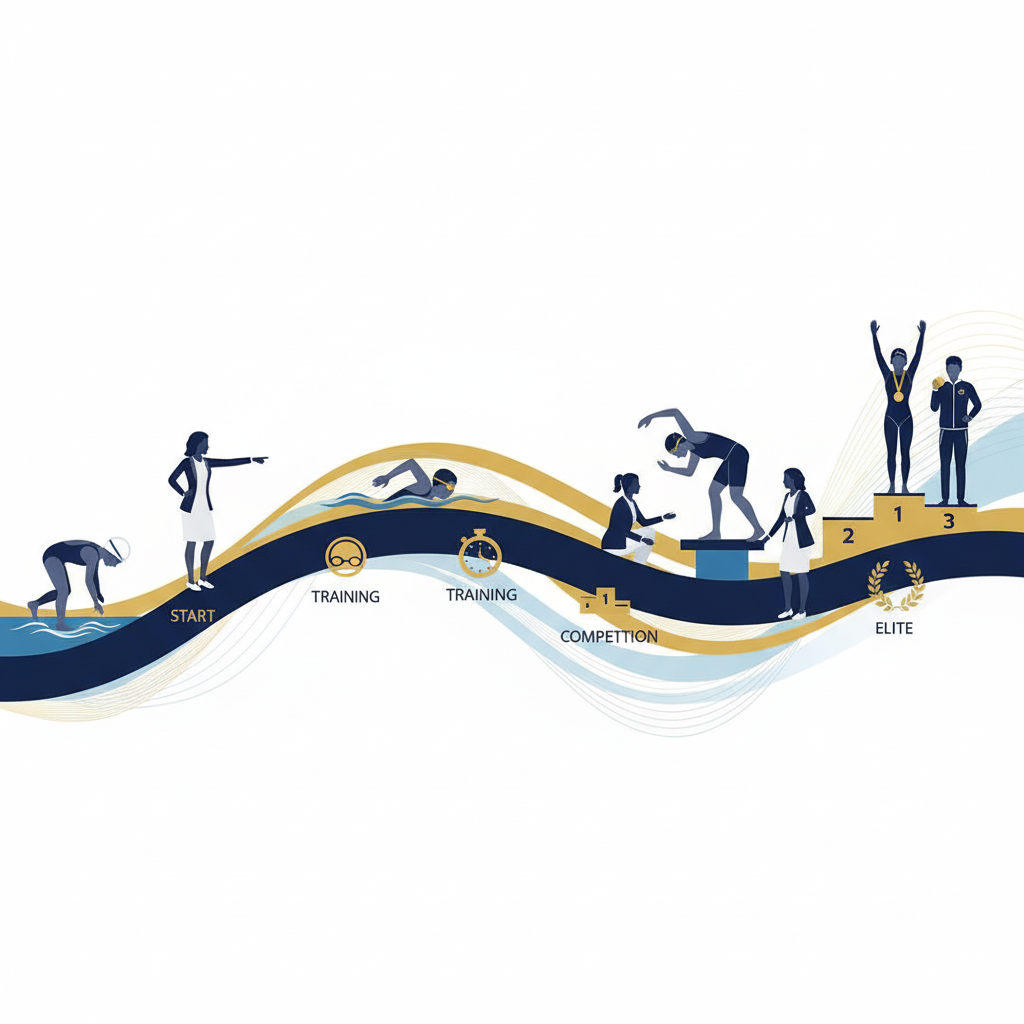
- 5 Career Stages: Foundation → Development → Specialization → Elite → Transition
- Performance peak: Average age 19-27, depends on stroke and distance
- 10-year rule: Average elite swimmer — 10 years of serious training before peak
- Specialization: Not before age 13-15 — develop all 4 strokes first
- Long-term cycles: 4-year Olympic cycle planning
1. The Five Career Stages
Every swimmer goes through 5 stages. The coach needs to know which stage the swimmer is in and adapt the plan accordingly:
📊 Infographic — Swimmer Career Stages
2. The Full Career Roadmap
Child in the pool — building love of swimming
- Goal: love of water, confidence, fun
- All 4 basic strokes — no competitive pressure
- Short sessions (45-60 min), 3-4/week frequency
- Success = swimmer who arrives smiling
Developing athlete — building foundations
- All 4 strokes AND individual medley — critical!
- Introductory competitions, self-measurement
- Gradual volume increase (20-35 km/week)
- Identify tendencies — which stroke and distance speaks to them
Competitive athlete — focus and performance
- Choose primary stroke + distance and secondary events
- Rising intensity — race pace sets, VO2max training
- National competitions, time standards
- Full annual plan with proper taper
Elite athlete — peaks and maximization
- 4-year Olympic cycle planning
- Personal bests, national/international representation
- Support team: physio, nutritionist, sports psychologist
- Fatigue management, injury prevention, burnout awareness
Smart transition — masters and future coach
- Masters swimming — maintaining active lifestyle
- Transition to coaching and teaching — experience → knowledge
- Preventing post-retirement “void” — plan early
- NIRMAKO: athlete = entrepreneur — second career
“A swimmer who burns out at 16 — the athlete didn’t fail. The coach who didn’t plan the career failed.” — Nir Makovsky
3. The 4-Year Olympic Cycle Plan
- Year 1 (post-Olympics): Rest, renewal, base building — no performance pressure
- Year 2: Strength and volume development — long-term investment
- Year 3: Rising quality — qualifying competitions, technical fine-tuning
- Year 4 (Olympic): Maximization — precise peaks at qualifiers, then the main event
4. Success Factors & Pitfalls
✅ Career Planning Success Factors
- Patience: Don’t push for peaks at young ages — damages body and motivation
- Variety: All 4 strokes until age 14 — broad neuromotor foundation
- Measurement: Clear KPIs at each stage — not just race times
- Mental health: Address pressure, failure and expectations — part of the plan
- Education: Not “sports or studies” — coach builds a whole person
- Retirement planning: Start talking about “what’s next” from age 20
⚠️ Common Pitfalls — What Not to Do
- Early burnout: Early success → high expectations → dropout at 17
- Early single-stroke: Specializing before 13 — limits overall potential
- Volume as only metric: km/week ≠ quality — Intent in training matters
- Parents as second coaches: Managing parent expectations is a critical coaching skill
- No real rest: At least 4-6 weeks completely off swimming per year
NIRMAKO · SWIMMING COACHES
Ready to Build Career Plans for Your Swimmers?
Learning materials, templates and guides for athlete career planning — NIRMAKO professional platform
Frequently Asked Questions
At what age should a swimmer specialize in one stroke?
Generally between ages 13-15. Developing all four strokes before that is essential. Early specialization can lead to early dropout and limits long-term potential.
How long does an elite swimming career last?
On average 8-12 years from the start of serious competition. Swimmers typically peak between ages 19-27, depending on stroke and distance.
How do you prepare a swimmer for an Olympic year?
Plan 4 years ahead: Year 1-2 base and development, Year 3 rising quality, Year 4 — precise peaks at qualifying competitions then the main event.
Business coach, CEO of NIRMAKO, TAB Israel partner. Active in swimming coaching and coach development.